FAQ
Frequently Asked Questions: About modular
Modular building is a method of design and construction which produces uniform, multipurpose buildings which can easily be installed and removed to produce a temporary space. Without the need for permanent foundations, the modular concept also inherently lends itself to scaling up and down as the demand for space changes. If you are considering hiring buildings for a project, to supplement your workspaces or classrooms, then Ausco Modular has a flexible solution for you.
No. Many of the same materials, fixtures and fittings that are used in traditional construction are also used in modular construction. We use a range of leading brands in the construction of our buildings and are proud of the quality of our buildings.
Modular buildings can be temporary, permanent, or a combination of both, depending on how they are designed, installed, and used. Ausco Modular delivers solutions across all three scenarios, allowing buildings to support short-term projects, long-term operations, or evolving needs over time.
Temporary (hire) modular buildings are compliant to the NCC at the year of build and designed for short-term or project-based use and are available across all Australian states. They are commonly hired by industries such as construction, mining, education, government, and technical services.
Typical hire buildings include:
Hire periods are flexible and can be adjusted to suit changing project timelines and operational requirements.
Permanent modular buildings are designed and manufactured as long-term structures and are built to meet the requirements of the National Construction Code (NCC). They are used across a wide range of sectors, supporting durable and compliant building outcomes.
These buildings are commonly delivered for:
- Education and sporting facilities
- Primary healthcare facilities
- Regional and remote communities
- Remote worker accommodation
- Renewable energy generation facilities
Permanent modular buildings are designed to offer the same durability, performance, and lifespan expectations as traditionally constructed buildings.
Many modular buildings, particularly Ausco Modular’s temporary hire buildings, are designed to be relocated, expanded, or reconfigured as needs change. Permanent modular buildings can also be moved, although this requires planning around service connections such as power, water, and sewerage. This modular approach allows buildings to adapt over time, rather than being locked into a single location or use.
Yes. Ausco Modular buildings are designed and delivered to meet relevant Australian building codes and standards, with compliance requirements assessed based on the building’s location, use, and duration.
All Ausco Modular buildings are designed in accordance with the National Construction Code (NCC).
Depending on where the building is installed, additional standards and local council regulations may apply. This can include Bushfire Attack Level (BAL) requirements, cyclonic wind ratings, and energy efficiency considerations. These compliance needs are addressed across both hire buildings and permanent modular installations.
Ausco has extensive experience delivering compliant modular buildings for government, health, mining and education sectors, including projects in remote and regional locations such as Groote Eylandt, Windorah, and Broome.
This experience helps ensure buildings meet the required standards while navigating local regulations, site conditions, and approval processes.
Modular building uses state of the art, purpose-built factories to complete much of the construction task in a production line environment. Skilled tradespeople work as a team to deliver a high quality, reliable and consistent building, that is then transported to site and assembled. Assembly on-site is a relatively quick and easy process, as the building is completed and any services (eg electricity, water & the like) are connected and tested.
With much of the building work taking place off-site in purpose-built factories, delays due to adverse weather are all but eliminated. Also, time spent on-site is significantly reduced. Depending on the complexity of the site and design, the on-site time could be as little as 3-5 days!
It really depends on the complexity of the design and the site. What we can say with confidence, however, is that choosing to build with a modular construction company will save you time, meaning you can get in and start using your building sooner!
The time it takes to install a modular building depends on whether it is a temporary hire solution or a permanent installation and the project scope, as well as the site location, number of modules, and overall project complexity.
In most cases, the on-site installation of modular buildings is fast, with modules typically installed in days.
For temporary hire modular buildings:
- Sites with fewer than 5 modules can often be installed in a single day
- Sites with 5 to 10 modules typically take 2–3 days
- Larger or more complex setups may take two weeks or more, particularly where services (power, water, sewerage) and access infrastructure such as steps, walkways, and landings are required
Delivery lead times vary depending on location, and availability and logistics are assessed as part of the planning process.
For permanent modular buildings, timeframes generally include three stages:
- Design: Selecting from Ausco’s existing designs, such as offices, classrooms, primary healthcare facilities, social and government housing, or remote workers’ accommodation, can help shorten this stage. Custom designs may take longer.
- Manufacture: Once the design is finalised, manufacturing typically takes around 12–16 weeks, depending on production schedules and project requirements.
- Installation: Modules are installed on site in a matter of days, with additional time required before and after installation for site preparation, internal fit-out, and connection to local infrastructure such as power, water, and sewerage.
Timelines vary depending on the project scope and site requirements. Your local Ausco Modular service centre can provide guidance based on your location and intended use.
The cost of an Ausco Modular building in Australia depends on whether you choose to hire or purchase, as well as the location, number of modules, and overall complexity of the build.
For modular building hire, pricing is influenced by factors such as the hire duration, the size and configuration of the modules, transport and installation requirements, and any compliance considerations.
For purchased modular buildings, costs vary based on the design, class of building, including the number of modules required, internal fit-out specifications, site conditions, transportation, and installation logistics.
Location also plays an important role. For example, modular buildings installed in northern Australia may require Cyclonic wind classifications, while buildings in other regions may need to meet Bushfire Attack Level (BAL) requirements. These compliance needs apply to both temporary hire buildings and permanent modular installations, and can impact overall cost.
Because every project is different, the most accurate way to understand pricing is to speak directly with Ausco. Your local Ausco Modular service centre can help assess your requirements and provide guidance based on your location, timeframe, and intended use.
There are very few design restrictions with modular. Each module is built on a steel chassis that allows us great flexibility with design. We can add details like angled or curved walls, pitched roofs and, where needed, we’re able to build up as well as out! Need a lift? No problem!
Ausco Modular buildings are used across a wide range of industries in Australia, supporting both temporary and permanent needs. They are commonly selected where speed, flexibility, compliance, and access to location are critical.
Ausco Modular has a long history of supplying modular buildings for public, commercial, and community infrastructure, with solutions tailored to specific industry requirements.
Common uses for modular buildings include:
- Schools and training facilities
- Primary healthcare facilities
- Social and government housing
- Remote workers’ accommodation
- Modular changerooms
- Local and regional councils
Ausco Modular is also the preferred modular supplier for the AFL, delivering facilities that meet the operational and compliance requirements of elite sport.
Modular buildings are widely used in regional and remote Australia, where traditional construction can be challenging. Ausco has delivered projects in locations such as Groote Eylandt, Windorah, and Broome, supporting essential services in hard-to-reach communities.
Depending on where your building(s) are going (and in some cases the length of time the buildings will be there), you’ll likely need a Development Approval (DA) from your local regulatory authority. Our project managers may be able to help you through this process.
Frequently Asked Questions
I need help with an Ausco building
Please follow the guide below prior to contacting us with a maintenance request:
Air conditioning troubleshooting guide:
Problem: Unit does not start, restart and/or not blowing air
Possible cause: Power cut
What to do: Wait for power to be restored
Possible cause: Unit may have become unplugged
What to do: Check that plug is securely in the power point
Possible cause: Circuit breaker may have been tripped
What to do: Turn off the GPO and reset the circuit breaker
Possible cause: Battery in the remote controller may have been exhausted
What to do: Replace the battery in the remote controller
Possible cause: Compressor 5 minute protection has been activated
What to do: Wait 5 minutes and try restarting
Problem: Unit not heating or cooling
Possible cause: Doors and or windows are open
What to do: Close the doors and or windows
Possible cause: Inappropriate mode and /or temperature setting
What to do: Check that mode is correct ie Heat or Cool or Auto; and also check the temperature setting. This can be done by pressing the up or down arrow once (depending on if you want to check for heating or cooling temp) this will display the pre-selected temperature. Adjust to the required temperature. Note – the display will show the room temperature after approx. 30 seconds.
Possible cause: Air filter is dirty/blocked
What to do: Remove the filter from the unit and wash under the tap, refit the filter and turn the unit back on. Run the unit for an hour and check if there is still a problem. NB – cleaning the filter should be a regular part of your ongoing maintenance plan, at least once per month.
Possible cause: Air inlet of the outdoor area is blocked or restricted
What to do: Clear any or all obstructions – the air inlet requires at least 300mm clear space. Once clear, clean the coil if required and restart the unit. Run the unit for an hour and check if there is still a problem.
If, after an hour of running the unit is still not heating or cooling, please note down the serial number, manufacturer name and height and width, then request a maintenance call with your Ausco representative.
Problem: Unit making a “whirring” or “rattle” noise
Possible cause: Possible worn bearings or installation adjustment required
What to do: Note down the serial number, manufacturer name and height and width, then request a maintenance call with your Ausco representative.
Please follow the guide below prior to contacting us with a maintenance request:
Problem: Mini boil not working
Possible cause: No water supply
What to do: Check by turning tap on in sink – have the site plumber connect water to the building. Allow time for the mini boil to fill before re-trying.
Problem: Water is constantly running from the tap – mains water supply
Possible cause: Unit is faulty
What to do: Note down the mini boil brand and serial number, then log a service request with your Ausco representative.
Problem: Water is constantly running from the tap – booster water supply
Possible cause: Booster pressure set too high**
What to do: Site plumber to check Booster KPA and ensure it is set within range**. Once reduced to within the desired range, test the unit to see if the problem still persists. If the problem does persist, note down the mini boil brand and serial number, then log a service request with your Ausco representative.
** The buildings are water tested on mains water pressure and are designed to operate between 300 and 550 kpa
Please follow the guide below prior to contacting us with a maintenance request:
Problem: Roof leaking
Possible cause: Items added or screwed to roof
What to do: Apply silicone around screws or holes made in roof when adding items
Possible cause: Spreader bar used during delivery and installation has damaged roofing
What to do: Contact your Ausco representative to log a maintenance request
Possible cause: Damaged roof sheeting during delivery or installation
What to do: If you’ve used your own transport or installation company, contact them first. Otherwise, log a maintenance request with your Ausco representative.
When your hire period comes to an end, our team will send you a comprehensive checklist to guide you through the process. The most important elements will be to ensure all the Ausco products you hired (such as furniture and kitchen equipment) are accounted for and packed properly in the building. We will also give you instructions on preparing toilets, showers and wet areas for safe transportation. And finally, and most importantly, you will need to make sure there is no debris or loose items on the roof. As part of your responsibility as the hirer, you need to make sure nothing can come off the buildings during the transportation back to Ausco.
Frequently Asked Questions: 360° Solutions
As the name suggests, it is all the requirements, add-ons, services and furnishings which provide your best space to Work, Learn and Play. Our goal is that by contacting Ausco, we will get it sorted so all you need to is the job at hand.
Ausco Modular offer rental terms from six months to multiple years. This extends to our buildings and select furniture packages.
Yes! We do offer some buildings and furniture packages for sale. Our recommendation on whether to purchase or rent will depend on how long you think you will need the buildings and whether you would rather them financially classified as an asset or a cost in the project. This is a decision you will need to make at the start of your temporary building as we can't sell hired buildings and furniture to you.
If you are renting one of our 360° Solutions kits, they come standard with the required items you need to get started. You can always add additional furniture, equipment, services and add-ons to suit. The beauty of modular is it speed of construction and installation which means certain elements come standard.
If you are looking for a bespoke modular design for a more permanent structure then our in-house Design and Engineering team can work with you and your architects or designers to produce something beautiful and unique. More details.
Ausco Modular offers the security and peace of mind of our Building Renter Protection (BRP). Much like a damage waiver on a rental car, BRP is a low cost alternative to standard property insurance. More details.
Ausco Modular believes in the circular economy and maximising the usable life of our buildings to the benefit of not just our customers yet also to the ultimate goal of sustainability. The average Ausco Modular buildings has a 20-year lifespan.
Frequently Asked Questions
Ausco Modular hire rates calculations explained
Applied to a complete month, a fixed monthly rate as quoted is applied regardless of the number of days within the applicable month.
Applied to an incomplete or part month, a daily rate is applied to the hire period charged (number of days on hire). Typically, this charge will be used on your first hire invoice and your last invoice or credit note. The daily rate is calculated from the Monthly rate using the calculation. DAILY RATE = (Monthly Rate X 12)/52/7.
Used for one-off charges such as Transport, Installation or cleaning.
You may have noticed Weekly Rates as well as Monthly Rates on our quote, a weekly rate is provided for ease of comparison with the market only, it is not used in our invoicing. The calculation of the weekly rate on the Hire Quote is as follows: WEEKLY RATE = (Monthly Rate X (0.0328) X 7 (Days in a week)
Ausco Modular hire charges are invoiced in advance on the first of each month, the exception to this is your first hire invoice which will be issued to you in the days following the delivery of your building(s). Hire is invoiced from the day of delivery to the end of the current month, calculated using a daily rate.
Invoices will follow monthly, issued in advance on the 1st of the month for the full month, calculated using a monthly rate.
When your building(s) are returned you will receive a credit note, issued from the day after the building is returned to the end of the current month, calculated using a daily rate.
Being a modular building company many of our products are made up of many modules “complexed” or joined together to form one building, these are referred to as complex floors. Complexes will appear on your quote as a complete building rate. As each module is delivered individually and complexed together on site we also invoice per module, to help you identify all the modules that make up your building each module will be referenced, all you need to do is add them together.
To help understand this, there is an example of an invoice with an explanation of all its elements at the base of this page. All amounts and rates quoted are for illustrative purposes only. To help reconcile your own invoice, look out for the text in green on the invoice example pages, this tells you how it all adds up.
1.9% of building charges.
To update the email address where invoices are sent, please contact us and provide your customer number, contract number, preferred email address, and your account will be updated. You can reach us on national.hire@ausco.nousuat.com.au
There are several ways to make a payment for your invoice. Details for EFT banking, BPay and credit card payments are included. You can also set up a recurring charge on your credit card if you prefer. Please note credit card payments attract a 1% surcharge.
Other Charges you may see on your invoice
Ausco Modular's Building Renter Protection is a simple, cost-effective but comprehensive alternative to standard property insurance, specifically designed for modular building hire. The BRP Fee is 14% of the hire rate, only charged for the hire period. Excess is set at $1000 per module. For more information on this product visit our information page here
The Building Renter Protection Fee will automatically be charged to you in addition to the hire charges each month of the hire period unless you have chosen to take out and provide copies of the required current insurance policies. Please refer to clause 14 in our standard Conditions of Hire - Terms & Conditions for more information, along with information about insurance certificate requirements
Ausco Modular Definition of Damage: Ausco Modular expects that all goods are returned in a good and reasonable condition - fair wear and tear excepted. We also offer some tips on how to avoid post-hire charges when the time comes to return the buildings. You can find all of this information in our Definition of Damage brochure.
On return of your building, it is inspected for any damage or missing ancillary items. If anything is identified or missing, details will be noted, we will take a few photos and send them to you via an Equipment Damage Advice or Equipment Shortage Advice Notice.
Charges for damaged items will be issued on a Damage Invoice and missing items invoiced per individual lost item.
A standard cleaning charge applies to all returned buildings and goods. Any excess cleaning charges will apply when the need for specialised cleaning products or methods are required to return the product to a re-hirable state.
Frequently Asked Questions
Invoicing
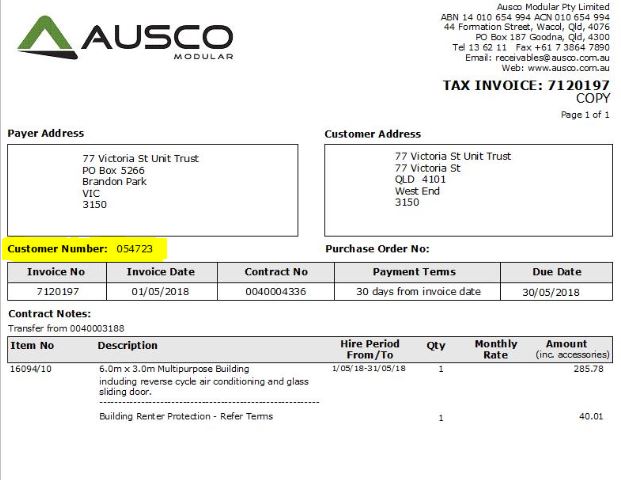
Please check your invoice for your customer number as shown below:
Simply email receivables@ausco.com.au or contact our Accounts Receivables Team on 07 3864 7873